
Hooten boasts of flouting the law
August 24, 2008
I guess you have to admire Matthew Hooten’s honesty for admitting that, as a Beehive staffer, he’s advised departments to breach the Official Information Act. And I don’t doubt that this government does the same thing. But I find this high-fiving about it pretty sickening:
As a Beehive staffer in the 1990s, I regularly “suggested” that departments delay the release of information that could embarrass the government. My personal best was 12 months, an 11-month breach of the law.
Topics: General, Official Information Act | Comments Off on Hooten boasts of flouting the law
It’s defiance, Susan, but not as we know it
August 24, 2008
Huh?
Here’s Susan Pepperell’s lead in today’s Star-Times story about the Sensible Sentencing Trust’s plan to “defy” the Electoral Finance Act:
Lobby group the Sensible Sentencing Trust is planning to defy the Electoral Finance Act in the lead-up to the general election.
Its evidence that this will be an act of defiance? Read on:
McVicar said Sensible Sentencing had sought a number of legal opinions on what they “could and couldn’t do” and received a variety of views. “Some said we would be skating on thin ice but no one said we would actually be in breach of the act.”
Not one of their legal advisors said they were breaching the Act?
I know the laws are murky, but how is this an act of defiance?
Topics: Electoral speech, Media ethics | Comments Off on It’s defiance, Susan, but not as we know it
It’s censorship, John, but not as we know it
August 15, 2008
Poor John Boscowan. He’s been censored.
I know this, because he’s got “censored” written across his full-page Sunday Star-Times ad opposing the Electoral Finance Act.
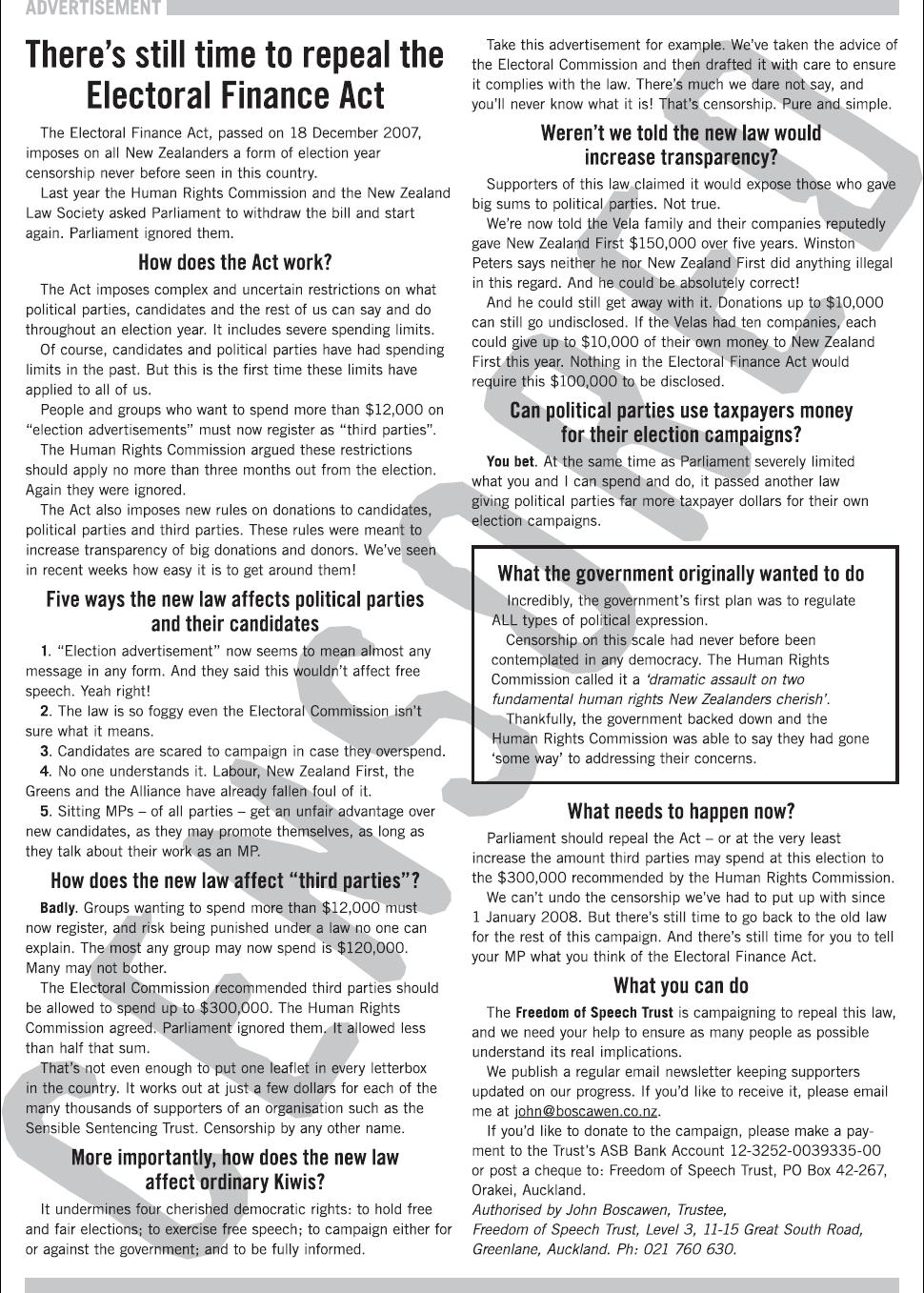
Yes, apart from being one of the few people in the country able to afford to express his views in 850 words in a full-page ad in one of the nation’s biggest newspapers, he’s been gagged.
And that gag is contained in the Electoral Finance Act. That dastardly law muzzles people like him wanting to spend money on political ads. They have to register and are limited to spending $120,000 if they want to publish an ad … like this one. Oh hang on. Not this one. No, this is an issue ad. It’s not caught by the EFA. So it doesn’t matter than John has spent more than $120,000, and hasn’t registered. In fact, his advice is that he doesn’t have to.
So what this ad really does is prove that you can still engage in some fairly nakedly electoral-type political speech without infringing the EFA. And John’s point was…?
Oh yes. “There’s much we dare not say, and you’ll never know what it is! That’s censorship. Pure and simple.”
“Dare not say” … because that speech is banned, and he’d risk prosecution for it? No. “Dare not say” because he’d have to register and be subject to the spending limits. So in fact, he could say pretty much anything he wants, but has chosen not to, in order to keep outside the EFA’s regime, which requires a degree of transparency and some financial checks that he doesn’t want to bother himself with. And fair enough, too. But this doesn’t look like censorship to me.
Fortunately for the good of the country, I am here to say the things that he fears not to. What he wants to say is: “Don’t vote for the parties who voted for the EFA”.
What? You thought that was pretty obvious, despite his transparent attempt to gussie up the ad as a plea to politicians to repeal the law? So again, we can thank John for demonstrating so graphically that the EFA isn’t censoring issue-related speech, even when it has a partisan flavour.
Well done, that man.
Topics: Censorship, Electoral speech, Protest speech | Comments Off on It’s censorship, John, but not as we know it
Keeping abreast of legal issues
August 15, 2008
Dean Knight and I have been debating one of the finer points of the Bill of Rights Act. We’ve been talking about how it might apply to the proposed boobs-on-bikes parade. (I gather an injunction application is being argued as I type).
The question relates to Bob McCoskrie’s [corrected spelling courtesy of Robyn: see comments] claim that the parade involves “sexualised nudity”. This presumably makes the nudity more offensive, and also suggests an element of lewdness that’s necessary for the charge of indecent exposure (and that might be missing, for example, from the naked bike protest).
It also relates to the extra protection that the Bill of Rights requires for political speech.
The debate goes something like this:
Steven: You know what? I think it might depend on the amount of jiggle.
Dean: I think that’s right.
Steven: If there’s more jiggle, then it looks more sexualised – so arguably more lewd and offensive. Then controlling the parade fits better with the purposes of the Local Government Act, and the offences of offensive behaviour and indecent exposure. You’ve got less wiggle room for an argument based on the significance of the speech. More jiggle – less wiggle.
Dean: No, I disagree. If there’s more jiggling, there’s more of a political component to the protest. It is deliberately provocative. It underscores the parade’s message being more open about sexuality. It emphasises that the protest is defying convention, and the council’s attempts to scotch it. There’s less reason to protect an unjiggly naked protest, because the nakedness is less central to the protesters’ purpose. Jiggling provides better grounds for a defence for boobs on bikes. More jiggle – more wiggle.
Such is the stuff of academic discourse. Though it’s fair to say that Dean doesn’t normally evince this degree of interest in women’s breasts.
Topics: Local government regulations, NZ Bill of Rights Act, Protest speech | Comments Off on Keeping abreast of legal issues
Dollar votes?
August 15, 2008
Russell Brown is pointing out that TV3’s election website is flogging profile pages to candidates at $299 a pop.
There’s no indication on the profile pages themselves that the MPs have to pay for them (though there is a “purchase page” tab on the main page that might clue readers in).
They’re also charging $399 for a favourable mention in Duncan Garner’s blog and $999 for party leaders to select their own soundbites in news stories. No, I made that up. Maybe next election.
The Press Council has upheld complaints against similar practices by newspapers, saying it:
breaches the traditional ethic of journalism to maintain a separation between the editorial side of a newspaper publication and the business side.
However, you can’t complain about a broadcaster’s website to the Press Council. Nor can you complain to the Broadcasting Standards Authority about broadcasters’ websites, even about the content of downloadable video (though you can complain about any content that’s actually broadcast, if you meet the complaint deadline).
It’s a bit of a gap in our regulatory framework.
Topics: Electoral speech, Media ethics | Comments Off on Dollar votes?
Auckland Council boob-oo?
August 15, 2008
Can the new Auckland Council bylaw requiring permits for (among other things) “any organised temporary activity including an organised gathering, parade, protest…” on public streets possibly be lawful?
Administrative law expert Dean Knight doesn’t think so. His terrific analysis concludes:
I am very confident in saying that, to the extent that the bylaw requires citizens to seek prior approval from a state body for a protest in a public place, it is patently inconsistent with the Bill of Rights and other fundamental common law rights, and is therefore unreasonable and invalid. There was, rightly, a public outcry a few years ago when Wellington City attempted to do this; it backed down. Also, it’s the very thing that many folk are pointing the stick at the Chinese government at the moment with the Olympics in Beijing. The requirement of prior approval is outrageous, particularly in the light of the restriction of protests and so forth.
Check out the Council’s flimsy Bill of Rights justification:
The council does not consider that the proposed bylaw is inconsistent with freedom of expression or freedom of peaceful assembly, or alternatively it considers that any limits in the bylaw are justified under section 5 of the NZBOR Act. The clauses do not prohibit the activities but rather impose reasonable conditions to ensure that those freedoms can be exercised in an orderly manner, and in a way that protects the public from nuisance, promotes and maintains public health and safety and minimises the potential for offensive behaviour in public places.
“Not inconsistent” with freedom of expression? It’s requiring a permit for a protest! The Council is giving itself power to refuse to allow a protest against it. This is like saying waterboarding isn’t inconsistent with the right to be free from torture. The real question is whether the restriction is demonstrably justified. The Council does address this, but after that start, it’s hard to have much confidence in its legal analysis. The fact that its section 5 analysis is one sentence long doesn’t help.
Dean rightly concludes that the extremely wide bylaw cannot be demonstrably justified, but thinks that a narrower one might be.
I’d add that the fact that the bylaw seems to have been aimed at the boobs-on-bikes parade means that the Council had a content-related motivation for passing the law – another reason the courts should treat it with suspicion.
Topics: Local government regulations, NZ Bill of Rights Act, Protest speech | Comments Off on Auckland Council boob-oo?
Upcoming privacy forum
August 13, 2008
If you’re interested in privacy, you might like to register for the Privacy Commissioner’s Privacy Issues Forum, to be held in Wellington on 27 August.
The programme includes a keynote speech from the Commissioner herself and a presentation on the Law Commission’s work on privacy by Sir Geoffery Palmer and John Burrows QC, as well as sessions on:
- Health: screening programmes and genetic research
- Controversial issues in dettecting an preventing crime (DNA and sex offender notification)
- Is good privacy good business?
- Employment and privacy
- Investigations (PIs and police)
- Technology (including social networking and foreign government access issues)
- A legal update on Privacy Act and privacy tort developments
- The Ombudsmen and the Privacy Commissioner
Topics: Privacy Act, Privacy tort | Comments Off on Upcoming privacy forum
But is it privacy?
August 13, 2008
The Evening Standard has printed an apology for falsely reporting that Prince Philip was suffering from prostate cancer:
We now accept that the story was untrue and that he is not suffering from any such condition. We unreservedly apologise both to him and to his family for making this distressing allegation and for breaching his privacy.
The apology was brokered by the Press Complaints Commission – further evidence that a complaints body is at its best when negotiating a quick solution to a media lapse.
Memo to our Press Council: this is another good reason to take up the recommendation of the recent review of the Press Council and establish a mediation arm.
But wait up. The paper got it wrong. Why is it apologising for a breach of privacy?
Gotta say, I’m not very comfortable with this. It seems to me that if you get something wrong, you’re not invading privacy, you’re committing some other sort of wrong. But I think we’re going to have to get used to this reasoning.
For one thing, as those who are frequently bagged in the media will tell you, media inaccuracies about you feel like an invasion of privacy.
More importantly, UK privacy cases are increasingly recognising that falsely reported facts can give rise to privacy issues. And the US has long recognised a strand of privacy that involves portraying someone in a “false light”, even if that false light isn’t strictly defamatory.
Still, this has the potential to blur the boundaries – especially between privacy and defamation. At the moment, it’s very hard to get an injunction in defamation cases, but it’s likely to be easier in privacy cases. Does that mean I can dress up my defamation case as a breach of privacy one, to make it easier to get an injunction? The UK courts seem to think they can resist this, but I’m not so sure.
Topics: Press Council, Privacy tort | Comments Off on But is it privacy?
When half a quote isn’t better than none
August 7, 2008
You might have spotted my star turn on One News last night. It was part of a story about National referring the taped-conversations affair (“CocktailGate”?) to the police. Might there have been a crime? Here’s the quote One News used from me, suggesting that I told them that the recording “may have broken the law”:
If you’re eavesdropping on somebody else’s conversation that you’re not part of, then you might be breaking the law if it’s clear that those people intend it to be private.
Well, true. But I went on to point out that there’s no crime if the people talking could reasonably expect to be overheard – which would probably be the case at a cocktail party. But TVNZ didn’t broadcast or mention that bit. Jessica Mutch, who conducted the interview, said she’d read my blog entries too, so she can’t have been in any doubt about my views.
But I guess that didn’t fit with the story they wanted to tell.
Topics: Media ethics | Comments Off on When half a quote isn’t better than none
Picking up the Bill II
August 6, 2008
So now John Key is accusing Labour of being behind the “bugging” of conversations at the cocktail party. He suggested on Morning Report this morning that the repeated questions put to Bill English about Kiwibank sounded like someone was trying to set him up.
(Key is also throwing in the suggestion that Labour was behind Nicky Hager’s acquisition of National Party emails. He doesn’t supply any evidence of this. That would be because Hager’s material was leaked from within National.)
Still, my previous post left an open question. What if Labour activists had bailed up English and secretly recorded the conversation? I noted that they wouldn’t then be “intercepting” the conversation, so wouldn’t have broken that law. I suspected that there would be public interest defences to any breach of confidence or privacy action, against them or the media.
But was the behaviour lawful? I rather doubt it. I’d need to know more about the openness of the venue, the restrictiveness of the guest list, how they got in, and what (if anything) they told anyone or lead them to believe, in order to get in. It seems likely that along the way, the infiltrators (if that’s what happened) committed the torts of deceit and trespass. There are no public interest defences to those.
The really interesting question: would the courts have granted an injunction to restrain the media from publishing the material if National got wind of it ahead of time? They would probably restrain material obtained during a trespass if the process of gathering it was “unconscionable”. Was this? Maybe. They would probably restrain material allegedly obtained in breach of confidence, at least in the interim, so that issues could be fully argued – in particular the public interest defence. That “interim” period could stretch on for quite a while…
[PS: Since the Privacy Act doesn’t apply to news media in their news-gathering activities, I tend to overlook it. But since those involved in the first-hand gathering of the recorded material here probably weren’t news media folk, the Privacy Act does apply to them. The relevant principle is IPP 4 – information should not be gathered using means that are unlawful, unfair or unreasonably intrusive. Again, lots will depend on the circumstances. But most people wouldn’t expect to have their cocktail party conversations recorded. On the face of it there seem to be grounds for a complaint to the Privacy Commissioner against whoever did the gathering.]
Topics: Breach of confidence, Privacy tort, Trespass | Comments Off on Picking up the Bill II
« Previous Entries Next Entries »