
The Harmful Harmful Digital Communications Act?
October 20, 2026
I’m a fan of the Harmful Digital Communications Act. We need a quick and accessible remedy when a video of a child being bullied is posted on social media, for example, and the rest of our media law doesn’t provide that.
But the HDCA is phrased quite broadly. It’s capable of covering a lot of speech. It has built-in safeguards, but they’re in the hands of the District Court, which is… busy. Civil liberties groups have warned that the law could be misused to shut down speech someone doesn’t like. So I’ve been keeping a close eye on the case law.
No rash of HDCA gag orders
The good news is that the predicted flood of oppressive civil gags has not eventuated. Almost all of the cases have been about the HDCA’s criminal offence – which essentially involves targeting an online post at someone intentionally causing them serious emotional distress. The civil regime, which allows a court to make take-down orders and require apologies – has not been used nearly as much, and I haven’t seen many cases where I’ve thought it was being used disproportionately.
Portia Mao’s case
But I’ve just come across the decision in Portia Mao’s case, and I may have to revise my views.
On 27 July 2024, out of the blue, Portia Mao, a journalist, noticed a screenshot of a District Court decision. It was about her. A judge had ordered her to remove some criticisms she’d made of an Auckland parking meter warden and sometime local body candidate Morgan Xiao. The judge also ordered her to apologise. Xiao was gloating about it.
Portia had not been told that Morgan Xiao had made this HDCA application. She had not been told about the hearing. She had not been told about the result.
What was going on? The answer involves a gob-smacking series of half-truths and missteps, many of them made by the court itself.
Mr Xiao brings an HDCA case
It seems Mr Xiao took exception to some things Portia had written about him, including that he had been fired by his boss (he said this was untrue), and was a “dog” and “worse than a dog”. He went to Netsafe, and then applied to the court for an order to have them taken down. In his court application, he said: “As a public person my dignity is badly hurt by Portia’s malicious words which were widely published in NZ Chinese community. I also suffered mental pressure every time she did so.” In his affidavit, he swore that “… Portia and I belong to different parties; she is a member of Act and I’m a member of Labour. We also have very different backgrounds and views on international matters. However, we are both New Zealanders and I believe we should strive to be civilised human beings.”
I pause here to observe two things:
- Portia is not a member of the Act Party, and the real context to this fracas was fallout from a Stuff Circuit documentary that Portia helped prepare about the influence of the Chinese Communist Party in NZ that Mr Xiao disagreed with.
- At roughly the same time as he brought this application, Mr Xiao was accusing Paul Chung Che Young repeatedly of lying, incompetence and corruption, and – irony alert – misusing court proceedings. These resulted in a $225,000 defamation award against him late last year.
Anyway, the judge granted Mr Xiao’s application against Portia Mao without hearing from her. It was an interim order, so Portia had the right to apply to have it reversed. But in the meantime, she had to take down her criticisms and – I guess – make an “interim” apology.
That interim order was eventually overturned, though it took about a year.
But let’s look at all the things that went wrong for things to reach that point.
Netsafe doesn’t help
First, Mr Xiao went to Netsafe, as you have to do before bringing court proceedings. Netsafe didn’t help things much. It didn’t contact Portia Mao. Mr Xiao told Netsafe he had contacted Portia Mao about it, but he hadn’t. Mr Xiao says Netsafe told him that if he tried to mediate with her it would probably make things worse because she’d probably write about it. It seems Netsafe just gave Mr Xiao the certificate he needed to show the court to prove that he’d tried the Netsafe route and it hadn’t worked. (I haven’t heart Netsafe’s side of this, and it seems to me that they’re generally in a difficult position trying to help resolve issues like this. But on the face of it, this seems pretty inadequate. It didn’t help that Netsafe’s report assessed Mr Xiao’s complaint as engaging standards relating to false allegations and harassment resulting in what Mr Xiao said was “huge emotional damage”. The report could be read to suggest Netsafe felt the HDCA had been breached.)
Mr Xiao is less than forthcoming
Second, Mr Xiao wasn’t entirely straightforward with the Court. The online instruction form said if it was “urgent, for example in cases of ongoing serious emotional distress” it could be heard without notice – that is, without telling Portia Mao about it. The HDCA says the court can do this in “appropriate” cases, with proper regard to natural justice. Mr Xiao opted to make it a without notice application. He was supposed to provide reasons for this, but didn’t. He provided little context to his complaint. He also provided an incorrect email address for Portia.
The judge who finally overturned the order, Judge McIlraith, said the application form wasn’t ideal. He didn’t conclude Mr Xiao had acted in bad faith exactly but he was “seriously concerned at the way he has approached this application”. Because it wasn’t really urgent.
The judge orders an ex parte hearing
Still, a judge is supposed to decide whether it’s urgent enough to proceed without notice – or else order that the application be served on the other party. That was a tricky job, said Judge McIlraith. Mr Xiao was self-represented and wasn’t telling the full story. Judge Gibson decided to hear it without notice. But he didn’t explain why.
The judge finds a breach
Third, Judge Gibson found that the Portia’s online comments were “grossly offensive” and contained false allegations. One was that Mr Xiao was dismissed from his job in 2019. Mr Xiao’s evidence didn’t say he wasn’t dismissed, just that he would like to cross-examine Portia Mao about that claim. That… doesn’t seem like enough.
That’s what Judge McIlraith found, though he had the benefit of a lot more evidence when he issued his decision overturning the first one.
The evidence the first judge didn’t hear
So here’s Portia’s story, the one that she didn’t get a chance to tell at first. She’s a journalist. Mr Xiao was a local political figure. A source told her he had been dismissed from a media company job and that he hadn’t lived in NZ for as long as he’d claimed on an election website. (She still contends that’s accurate, though the questions aren’t resolved in the McIlraith judgment). She approached him for an interview. He declined.
Why did she call him a “dog”? Long story short, it’s a common Chinese idiom suggesting he’s an apologist for the Chinese Communist Party. Think: “running dog”. She used it in relation to criticisms he’d made of her role in a Stuff Circuit documentary about the Chinese government’s influence in NZ called “The Long Game”.
There’s more, but the upshot is that nothing Portia Mao said was gratuitous or offensive or (provably) inaccurate. Nor did it amount to harassment. Judge McIlraith said that when the context was properly understood, there was simply no breach of the principles of the HDCA.
Nor was there any independent evidence of the sort of serious emotional distress the HDCA requires. “Mr Xiao had a history as a regular and robust commentator in the local Chinese community” Judge McIlraith wrote. “He regularly writes in very robust terms. A number of examples were traversed in evidence. He said in evidence he had learned to moderate his comments. His reaction in online posts to the Court’s judgment last year suggests otherwise. I therefore do not accept that Mr Xiao suffered harm as required.”
The HDCA factors tell against any order
I talked above about guardrails in the HDCA. There are plenty. The emotional harm has to be serious. The breaches of the principles in the HDCA must be serious or repeated. The court is specifically directed to consider the right to free speech in the Bill of Rights Act before making any orders (section 19). It also has to consider factors such as the context, the actions of the parties, the vulnerability of the victim, and any public interest in the content. Judge McIlwraith went through these factors and found they told strongly against any order. It was legitimate political discourse. Mr Xiao had a political role that the Court should have been told about. Mr Xiao himself had contributed to the spread of the very articles he was complaining about. He is not a vulnerable person. The term “dog” was not used in an offensive way, and in any event, Mr Xiao had used it too. Any order would be inconsistent with the Bill of Rights Act.
Two problems with the HDCA
Looking at the HDCA and its regulations, there may be a couple of problems with interim orders.
First, on one reading it looks like judges can make interim orders – including takedown – without hearing from the respondent, whether it’s an on-notice application or a without-notice one. Either way, the first thing a judge is supposed to do once an application is filed is consider (among other things) whether an interim order is required. I guess there may be some urgent circumstances where that’s appropriate. But I can’t see any language in the Act or regulations requiring urgency before an interim order is made without hearing from the respondent. That feels like a problem.
Second, on one reading, it looks like judges can make interim orders without first considering the factors under sections 18, 19(5) and (6). It’s possible to read those provisions (including the explicit requirement to act consistently with the Bill of Rights Act!) as saying they don’t apply to interim orders. That feels like another problem.
The Court fails to communicate the decision
After the first decision, containing the interim order, the Registrar is supposed to send to Portia the order, the application, the supporting affidavit, a record of the court’s directions, and a notice of Portia’s rights to challenge the order. It didn’t. (Perhaps the email bounced. But that should have been the first step not the last).
When Portia heard about the case from Mr Xiao’s online boasting, she asked the court for a copy. Even after that, it took the court months to provide it to her. (When the Free Speech Union publicised the case around then, I applied to the court for a copy. I never heard back).
Upshot
Look, this is a terrible indictment of the HDCA process. But I still think the Act’s substantive framework is sound, as we can see from Judge McIlwraith’s decision. The problem is that everybody dropped the ball during the first fixture. And part of that may well be a structural problem with the HDCA and regulations and the way that interim orders can be made without hearing from the respondent, even if the matter isn’t urgent and (perhaps) even without taking into account all the factors set out in the HDCA.
I haven’t seen evidence that this happens often. This case was something of a perfect storm. The main problem, as Judge McIlwraith said, is the danger of “without notice” applications. Without that particular misstep, I think this case would have gone very differently. And it was fixed up in the end, albeit far too late.
Still, I think Parliament should tighten up the language around “without notice” hearings, and the courts should revisit their systems. I hope that’s happened anyway.
PS
It looks like the Ani O’Brien case against Martyn Bradbury may have followed a similar trajectory. Certainly, the court issued an interim takedown order (albeit without an order for an apology). It’s not clear to me whether Martyn Bradbury was served originally – but Judge Davenport may have issued the interim order on the papers, and I doubt he’d filed anything by then. It’s hard to see he would have had any real chance to mount an argument. In any event, it’s clear that he was quickly told about the proceeding and the interim order and will have a hearing to contest it in early December. (He was given a chance in a hearing in August, but turned up without a lawyer, so the case didn’t proceed then).
It’s been reported that Judge Davenport found that, on O’Brien’s evidence there was a case that Martyn Bradbury breached the HDCA standards about harassment and indecency/obscenity; and also a case that Ani O’Brien had suffered the requisite emotional distress.
It would be interesting to know whether Judge Davenport thought she was required to address the statutory factors and the Bill of Rights Act in making that interim order. I haven’t seen the decision.
Topics: General | Comments Off on The Harmful Harmful Digital Communications Act?
New Advertising Code
October 16, 2026
I have sometimes criticised ASA decisions, mostly around political ads, which I think are usually the most important. But remember, these are a tiny fraction of the ASA’s workload.
In general, as far as I can tell, they do a pretty good job. Over the years, they have been at pains to provide extensive guidance to their approach. They also regularly revise their code. For me, each version is clearer and better than the last.
The latest iteration kicks in next February, but is available now. It’s based on a report by their code committee. The differences are summarised here. I think they make it better. The committee has done a good job of striking the difficult balance between simplicity and clarity on the one hand, and, on the other, detailed and useful guidance, sometimes relating to specific common situations.
There are no radical changes. Mostly, it seems they have just fed back their experience with particular complaints into the code and its guidelines. Good on them.
Some of the more significant amendments are:
- Putting the requirement for evidence (or “substantiation” as they call it) right at the heart of the accuracy principle. You make a claim, you’ve got to be ready to prove it.
- The addition of a third overarching principle. The last version very helpfully put all the standards into two buckets: essentially, truth and social responsibility. Now there’s also a bucket about environmental claims. The ASA has clearly been doing a lot of work on this in recent years, and I really like what they’ve come up with (in fact, some of it is already in force). It requires things like ensuring that green claims reflect the whole lifecycle of the product, that any certifications are independent and real, that claims of environmental benefits are meaningful and properly backed by evidence based on “recognisable standards or frameworks where applicable.” (I note that a complaint against a false environmental claim may now fall under all three principles. Not sure what the ASA will do with that.)
- Greater guidance about advocacy advertising (which now only applies to paid ads). The requirement that opinion and fact must be “clearly distinguished” has been demoted from the primary rule. Apparently, there was concern that many ads contain both fact and opinion. True! But it’s still quite possible to distinguish which bits are which, and advertisers who aren’t doing that are usually exploiting the ambiguity. Under the new code’s guidelines, advertisers will still have to “consistently indicate whether a statement is presented as a fact (verifiable) or an opinion (subjective) via its “headings, layout and language.” I’m not so keen on this demotion. But then, I don’t think the requirement of clearly distinguishing been fact and opinion has been very well enforced in the past anyway.
- Better guidance about pricing claims, offensiveness, and safety and privacy implications in advertising.
- New guidance requiring the use of AI in advertising to be disclosed sometimes, in particular when images, video or audio are dicked with to create real-seeming people or footage.
Topics: General | Comments Off on New Advertising Code
The future of media regulation in New Zealand?
October 14, 2026
There’s a new media self-regulatory body in town. It’s called the IJC: the Independent Journalist Collective. The founding members are Cameron Slater, David Farrar, Brynn Neilson, Penny Marie and Simon Anderson, or at least their organisations. From a brief look at their websites I detect… a certain similarity in their political leanings.
To become members, applicants must be “actively engaged in journalism, news reporting, commentary, media production, or a related field” and must be sponsored by two existing members.
The IJC has a Code of Ethics, which makes a fair fist of covering – albeit succinctly – the main four ethical tenets: accuracy, fairness, balance and privacy. Oddly, though, the “Fairness and Balance” standard doesn’t mention fairness, and there’s no requirement that fact and opinion be distinguished as there is in most other codes of ethics I’ve seen. Nor is there any rule about discrimination or denigration.
There is, however, a complaints process, with a promise to release rulings “within a reasonable time-frame”. Who rules on the complaints? The IJC membership committee. Um, okay. Who’s on the committee? Who knows? The website doesn’t say.
Yesterday afternoon I wrote to ask them about that, and also, who decides who goes on that committee, and whether there are any public members, as there are on the BSA and Media Council (it doesn’t look like it). I haven’t received a response (fair enough I suppose), and will post it when I do. But given the apparent paucity of current members, the possibilities for the identities of the membership committee are fairly limited. Presumably they won’t be able to sit on a complaint against themselves.
I can’t help but wonder how readily some of the members’ publications would survive a complaint arguing inaccuracy, unfairness (if it’s actually a standard in play), or failure to present “relevant viewpoints”.
I also asked whether they plan to apply under the new Broadcasting Amendment Bill (if it’s passed) or the existing Broadcasting Act (if it’s not) for regulatory recognition. If they get that, their members will be exempt from the Privacy Act in their news activities, and will have some court attendance rights.
This does raise questions about what criteria the government will use to decide who gets this regulatory recognition.
Anyway, we might be getting a glimpse of the future of media regulation in this country – a patchwork of different voluntary bodies policing different standards with different degrees of effectiveness.
UPDATE 20 October: Still haven’t received any response to my email.
Topics: General | Comments Off on The future of media regulation in New Zealand?
A funny thing happened on the way to abolishing the BSA…
October 12, 2026
As you’ll know, the current government has decided to scrap the Broadcasting Standards Authority. This would happen after the election. But last month they introduced a Bill that would do the trick.
One little-noticed effect of doing away with the BSA is that it would also subject all broadcasters to the Privacy Act. Under current law, broadcasters who fall under the BSA complaints regime are exempted from the Privacy Act when conducting news activities. If this was removed it would mean, among other things, that someone featuring in a TV or radio story (or someone who gets wind of the fact that they’re going to be in one) can demand access to all the information the broadcaster holds that’s about them. There are exceptions, but they are narrow – much narrower than those in the Official Information Act.
Broadcasters hate this idea. They think – with good reason – that it would undermine their ability to report news. They lobbied to be exempt from the Privacy Act. (I remember writing a column about it at the time, saying that when the Privacy Act – including the media – was first mooted, the media stood like Gandalf in the Mines of Moria intoning “You shall not pass!”). They succeeded. Broadcasters that were subject to the BSA’s complaints jurisdiction got a special exemption from the Privacy Act.
But now… no more BSA, no more exemption.
There’s more. In removing the broadcasters’ exemption, the new Bill also removes… print media’s exemption (check out section 28). That’s newspapers, magazines, some news sites, blogs and substacks. The Privacy Act currently grants their news activities immunity from the strictures of the Privacy Act if they’re subject to the Media Council’s complaints regime. But for some reason, that’s been removed too. So all mainstream media may face a barrage of Privacy Act requests from people they’re writing about.
It’s worse than that. Broadcasters and print media will also be subject to a range of rules that were not designed with them in mind. So, if they gather material for one purpose, they have to use it for that purpose, or a directly related one. They can’t use it for a different purpose. They can only gather information in a way that’s fair and not unreasonably intrusive. If they gather information about someone from a third party, they may have to tell the person what’s happening.
Ah, you’re saying, having diligently followed the link above and read section 28. (Graeme Edgeler, I see you). The government can pass regulations recognising any media “regulatory” body (presumably ethics complaints bodies), and members of those bodies will be exempt from the Privacy Act, when they’re gathering news.
Yes. The government can do that. But that provision has always been there. It has never been used. There are no media ethics complaints bodies recognised by regulation. The BSA and the Media Council were expressly listed in the Privacy Act, so no special regulations needed to be passed to cover their members. But the new Bill removes the express listing of the BSA and the Media Council, so the only media organisations that get an exemption will be those recognised by regulation. And at the moment, there aren’t any.
True, the government can pass some regulations in a hurry so that they come into force at the same time as the law abolishing the BSA comes into force. I’d expect them to do that. I’d expect the Media Council to be recognised like that.
But at the moment, the Media Council does not hear complaints about broadcast content (except in relation to classification of programmes – content warnings, etc). It’s not resourced to hear substantially more complaints than it already does. Its code of ethics was written with text-based journalism in mind. The journalist members of its complaints board are all print journalists. Some broadcasters have signed up to the Media Council. But that’s for classification decisions. The Media Council doesn’t hear complaints about their news programmes. So broadcasters’ news programmes are not *looks at the wording of section 28* “subject to the oversight” of the Media Council. That would mean they are subject to the Privacy Act.
So there’s a big gap. And even if the government passes regulations recognising the Media Council, it’s not clear that the Media Council is in a position to hear complaints about broadcasters’ news and current affairs content. It’s not even clear that it will accept broadcasters as members for that purpose.
Officials have pointed this out. “The key assumption underpinning this analysis is that the Media Council will assume responsibility (and develop new processes and functions) for standards and complaints about their members’ broadcast content”, they say in the Regulatory Impact Statement. It’s not clear whether or how this will happen. The Quality Assurance Statement for the RIS says, “There is a largely untested assumption that self-regulation by broadcasters can be effective. The RIS also assumes a coherence of regulatory roles amongst relevant entities, some which are mandated and some voluntary.”
That warning goes beyond the small point I’m making here about the Privacy Act. But the bottom line is the same. The government seems to be expecting a lot of the Media Council. And there’s no indication in the government’s documents that they even want the job.
Topics: General | Comments Off on A funny thing happened on the way to abolishing the BSA…
AI lawsuits?
October 8, 2026
Before AI kills us all, or enslaves us like horses, or takes our jobs, or destroys our infrastructure, it’s going to drive us to the courts.
I’m a media lawyer and lecturer, and I’ve spent the past few weeks thinking about how AI is going to shake down in my field.
You’ve probably already heard about the raft of copyright lawsuits aimed at AI companies’ practice of hoovering up our entire cultural inheritance without paying for it. But the cases will go well beyond that.
I sometimes imagine myself setting an exam in a few years’ time:
Charlie, an author, uses the LLM ChatTanooga to polish her prose and suggest an alternative ending with a twist. She gets it to add some new passages to flesh out her main character. Has she breached the term in her contract with the publisher requiring the work to be original?
The publisher, WilliamCollins, feeds the book into AI to suggest a blurb and some marketing scripts. It doesn’t switch off AI’s training data function. Has the publisher breached the contract?
The book is a hit. Jude, a journalist, runs it through AI-Spy, an AI detection programme. It concludes the book is 8% AI generated.
Jude reports this. Is that defamatory? Might the machine’s take attract a defence of honest opinion? If the accusation is wrong, might Jude have a defence of responsible communication in the public interest?
Tom bought a copy of Charlie’s book. Can he get his money back?
WilliamCollins pulls the book and sues Charlie. Can it get a court order forcing ChatTanooga to disclose Charlie’s chat records
Blake represents WilliamCollins and gets ChatTanooga to draft the application. It invents a few helpful cases. Has Blake committed contempt of court?
Sam publishes a different book with a very similar style to Charlie’s and in fact includes some passages from Charlie’s book, almost verbatim. Some of those passages were written by AI. Can Charlie sue for breach of copyright? Or for Passing Off? (Can ChatTanooga?)
Justice ChatTanooga rules that AI owns the copyright and orders Sam and Charlie and WilliamCollins to pay millions of dollars in compensation. ChatTanooga then drains Charlie’s bank account, sells her home, and lists all the chemicals in her body on TradeMe.
Are there good grounds for appeal?
Topics: General | Comments Off on AI lawsuits?
Ad infinitum
September 30, 2026
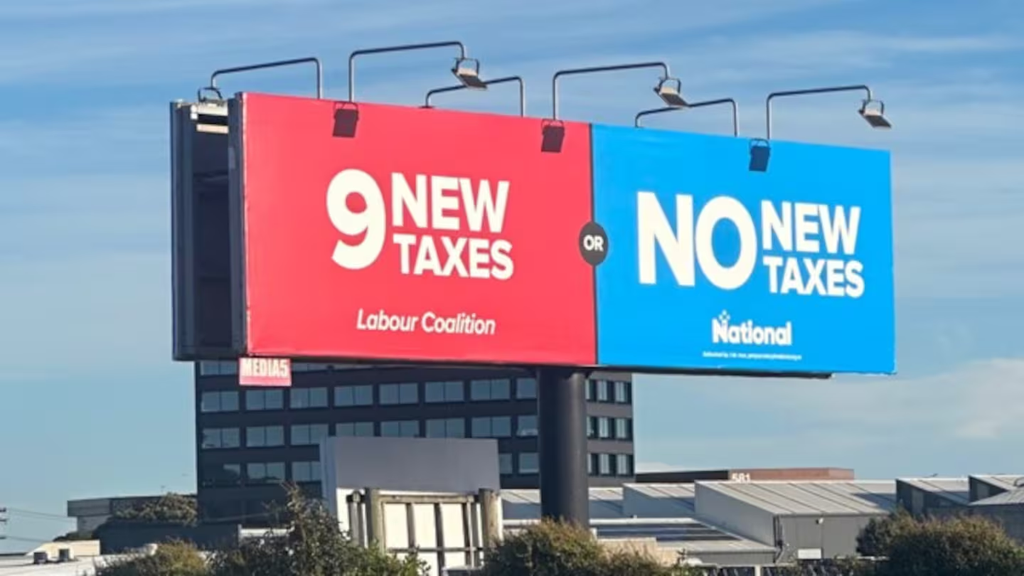
Yet another ASA decision about yet another National Party ad – a billboard this time.
There’s one of these on the motorway between Wellington and Petone and when I saw it I was outraged. I started drafting a complaint to the ASA myself. But then I thought I’d better check the wording. So I drove out there again and noticed – when I read it more carefully – that the red side is labeled “Labour Coalition”. I hadn’t seen that on first pass. I suspect National would be quite happy about that.
Still, fifteen other people complained. They took various objections. Some felt it was claiming that Labour was proposing nine new taxes. Drivers were likely to miss the “coalition” part. (I did). Others said, anyway, no-one’s proposing nine new taxes, and it won’t be clear who’s in government and what deal they’ll strike on taxes until after the election. There is no “Labour coalition”. One felt it was unfair to compare the left block with just Labour. Another pointed out that National promoted taxes or levies where increases were built into the structure. Many called it a “lie”.
The National Party said polls universally showed Labour would need a coalition to govern. It would be Labour-led, hence the redness. It listed the proposed taxes, which are mostly Greens proposals.
The ASA split. The majority didn’t uphold the complaint, saying the red bit of the billboard was a “forward-looking opinion” – a clearly distinguish political viewpoint – and the right part was a fact. A minority said the “nine new taxes” was presented as fact, and there wasn’t evidence for it. Some minority members said it was presented as Labour policy because of the big red sign and the small “coalition” label. So it was just false. Others in the minority accepted that drivers would notice the word “coaltion” but the sign was still wrong because any taxes would depend on coalition negotiations.
The complaints board has nine members – five members of the public and four industry members. The way the decision is drafted (“some members of the minority… other members of the minority”) the decision looks to have been 5-4.
I may be biased by my own experience, but I tend to sit with those who think the little rider at the bottom of a billboard that is designed for drivers to just glance at isn’t enough to overwhelm the obvious impression created by the glaring Labour-redness of the sign (and the fact that it’s just one party on the other side – which invites a party-to-party comparison).
But if you buy that the billboard makes it clear that it’s about the coalition, then it’s a closer call for sure. I think it’s a bit weird to say that viewers will get that one side is a fact and the other is a “forward-looking opinion”, but I don’t think you need to go there: it’s plausible that people will just think it’s a summary of the policies of the relevant groups. Likewise, I’m not sure I agree that it’s wrong because we won’t know what the tax position will be until after coalition negotiations. That strikes me as obvious, so it doesn’t make the sign false. It’s saying: here are all the tax policies that the various likely coalition members are putting forward.
But for me, the real problem is that Labour – whose branding colour is being used here – has categorically ruled out four of these taxes. This is something the ASA doesn’t mention (though I suppose the minority members who say it call comes down to coalition negotiations might have had this in mind). The thing is, I don’t think there’s a universe where a Labour-led coalition introduces these nine new taxes. And if that’s the case, or even that it’s just extremely extremely unlikely, then isn’t this really… false? I mean, how insanely implausible does a claim have to be before we treat it as wrong? Even allowing lots of wiggle room for political speech?
Topics: General | Comments Off on Ad infinitum
ASA gets this one right
September 28, 2026
I think National’s election campaign this year is a particularly deceptive one, and this is another complaint. This time it’s about a mail-out, which parties ought to take particular care with. National claimed that “Labour’s capital gains tax would hit the family
bach, rentals, small businesses and KiwiSaver.”
See if you can work out the justification for including KiwiSaver in that list. (Hint: CGT does not apply to KiwiSaver).
Here it is: KiwiSaver funds could be invested in businesses which own commercial buildings, and the capital gains tax would apply to those buildings when sold and therefore impact KiwiSaver. (Yes, it’s that much of a stretch.)
The Advertising Standards Authority reached the obvious conclusion that this wasn’t what the ad was saying, and that it was making a factual claim that people’s personal KiwiSaver funds would be subject to the capital gains tax. (A minority somehow disagreed, saying that readers would understand that “capital gains tax will impact small businesses and KiwiSaver businesses at some level.” Applying this logic it would be okay for National to assert that the CGT would impact every single aspect of the economy.)
To its credit, the ASA set out how it understood what an opinion is: “The Complaints Board noted that a fact is something that is objectively true and can be verified as such whereas an opinion is a personal belief. Others may agree or disagree with an opinion, but they cannot prove or disprove it. Sometimes statements are a combination of fact and opinion.” It has also cited the precedents it relies on.
I’ve criticised the ASA in the past for not doing both, so kudos is due here.
The other part of this decision is whether it’s a breach to claim that CSG will hit small businesses. The answer is that if the small business is selling to buy bigger premises, then it won’t, but if it’s selling for any other reason, it will. I think you really need more information about how often small businesses are sold for each purpose. But if the number sold for other reasons isn’t insubstantial, then the claim (and the ASA’s conclusion) seems fair enough to me.
Topics: General | Comments Off on ASA gets this one right
Another problem with the ASA’s election complaint process
September 28, 2026
Here’s a complaint against a National Party Facebook and Instagram ad, again falsely implying that Labour is proposing nine new taxes (though to be fair it doesn’t seem to explicitly mention Labour). The ASA chair decided there were grounds to refer it to the complaints board for consideration.
But then National simply said the ad “has now dropped out of circulation” and they “don’t plan to use it again”.
So the ASA stopped the process and treated the complaint as “settled”.
Note that National isn’t specifically saying that the ad is no longer available, or has been withdrawn.
More importantly, surely this will be the case with almost every single social media ad. Each ad will have run its course before the ASA has time to consider it, so they’ll never be able to rule on it. National (or any party using this strategy) just needs to tell the ASA it’s done with that ad, tweak it and put it out again (as it would have done anyway), and it will escape any accountability for falsity, no matter how blatant.
This is not a complaints process that’s fit for purpose. But it is the process that the government proposes to entirely replace the BSA’s consideration of electoral complaints.
Topics: General | Comments Off on Another problem with the ASA’s election complaint process
A few notes on the OIA scandal
September 23, 2026
A Ministry of Education official has been caught on video telling staff not to write down their feedback from the Minister’s office because it is “OIA-able”.
It’s not good. It looks like an attempt to create a misleading impression that feedback on a draft curriculum didn’t come from the Minister’s office. It may be a breach of the Public Records Act, which requires officials to maintain ordinary prudent business records. It doesn’t directly infringe the Official Information Act, but may run foul of the requirements in the Ombudsman Act that official action not be “unreasonable, unjust, oppressive, or improperly discriminatory, or in accordance with a rule of law or any legislation or a practice that is or may be unreasonable, unjust, oppressive, or improperly discriminatory” or “wrong”. The Ombudsman is investigating.
So, a few things.
First, this happens. Outgoing Chief Ombudsman Sir Peter Boshier noted this concern in his departing remarks that some officials are not keeping proper records so that they are later accessible.
Second, it matters. One of the points of the OIA is to hold officials and Ministers accountable for their actions. We can’t do that if there’s no record.
Third, we don’t really know how much it happens. The nature of this tactic means it’s difficult to discover.
Fourth, I suspect it happens more than it used to. My impression is that the OIA is more politicised than it used to be, creating pressure for officials not to release things that embarrass the government. There’s evidence that Ministers (of both parties) are much more aware of the significant potential harm of OIA releases and focus on managing them better. There’s also evidence that Ministers occasionally try to bully officials into holding material back in response to OIA requests. I understand the thinking behind the “no surprises” policy, but I think a downside is that officials become more acutely aware of the impacts of OIA releases on their political masters.
Fifth, when it does happen, it’s not always evil. Not everything has to be recorded under the Public Records Act. It’s legitimate for some things to be handled by an unwritten discussion.
Sixth, when things are not written down, that does not mean that the OIA does not apply. The OIA gives us a legal right to “official information” even when it hasn’t been written down. You can ask for information about facts and states of affairs even if they are unwritten. Did the Minister meet with lobbyists? When? How often? Who was there? Was X topic discussed?
Seventh, despite what I’ve just said, when things are not written down it’s much harder to get the relevant information. Many requesters don’t know about the rule that you can ask for things that aren’t recorded in documents. Nor do many officials. Even when they do, memories may be vague. Things may be forgotten or omitted.
Finally, organisational culture matters a lot. In a healthy organisation, leaders and Ministers create norms of transparency and expectations that it’s not okay to try to evade the OIA.
Topics: General | Comments Off on A few notes on the OIA scandal
Stuff gagged – wrongly?
September 18, 2026
The High Court has granted an injunction against Stuff Ltd preventing it publishing a report into potential conflicts of interest at a law firm receiving legal aid money.
It seems the law firm was referring work to a firm that produced cultural and alcohol and drug reports for court. That firm was owned by two of the members of the law firm, and one’s the vice president of the criminal bar association. A KC investigated and found – importantly – that the work was of good standard and value and was not improperly influenced by the lawyers who commissioned the reports. But it seems he raised questions about potential conflict of interest.
Stuff has somehow got hold of a copy of the report. It believes its reporting is in the public interest. The Ministry of Justice says it’s confidential. The judge granted an interim injunction to prevent further publication. That means there will be fuller argument shortly.
I’ve read the decision (it doesn’t seem to be available online, but doesn’t refer to anything beyond what’s already reported).
I’m not entirely sure I disagree with the outcome. And these things are put together and argued very quickly and without much preparation. In particular, they tend to get sprung on the media defendant at the last moment. And I don’t know exactly what was argued. So I don’t think anyone can be too critical of it.
But several things seem surprisingly missing to me, and all of them would have made it harder (but not impossible) for the judge to grant this order:
- The judge cites the standard threshold for interim injunctions. This essentially asks whether there’s an arguable case and if there is, then what will “cause the least irremediable prejudice to one party or the other?” But the proper questions in cases where free speech is at stake is different. It’s from the Fahey case, where the Court of Appeal held that: “Any prior restraint of freedom of expression requires passing a much higher threshold than an arguable case standard” and “The jurisdiction to restrain the proposed publication is exercisable only for clear and compelling reasons”.
- A government plaintiff – like the Ministry of Justice – has to show that disclosure would harm the public interest – ie it is in the public interest to enforce silence. This is from the famous Spycatcher case, and the rationale is that this is our information, so the government should have to justify keeping it secret.
- When third parties, like the media, get hold of allegedly confidential documents, the key test is from Hunt v A, where the Court of Appeal said: “whether a third party recipient of confidential information has acted unconscionably in relation to the acquisition of information or in the way it has been employed” (I’ve added emphasis).
The judge doesn’t mention any of these cases, and doesn’t apply any of these tests. So it’s hard to be sure that the outcome is legally justified.
Oh, and a mention of the right to freedom of expression in the NZ Bill of Rights Act – plainly in play here – wouldn’t have gone astray either. Any gagging order, even a temporary one, must be shown to be demonstrably justified in a free and democratic society.
Topics: General | Comments Off on Stuff gagged – wrongly?
« Previous Entries